
Healthcare AI Blog | Steer Health
Practical thinking on patient access, growth, and the autonomous workforce taking over the busywork that should never have required a human.
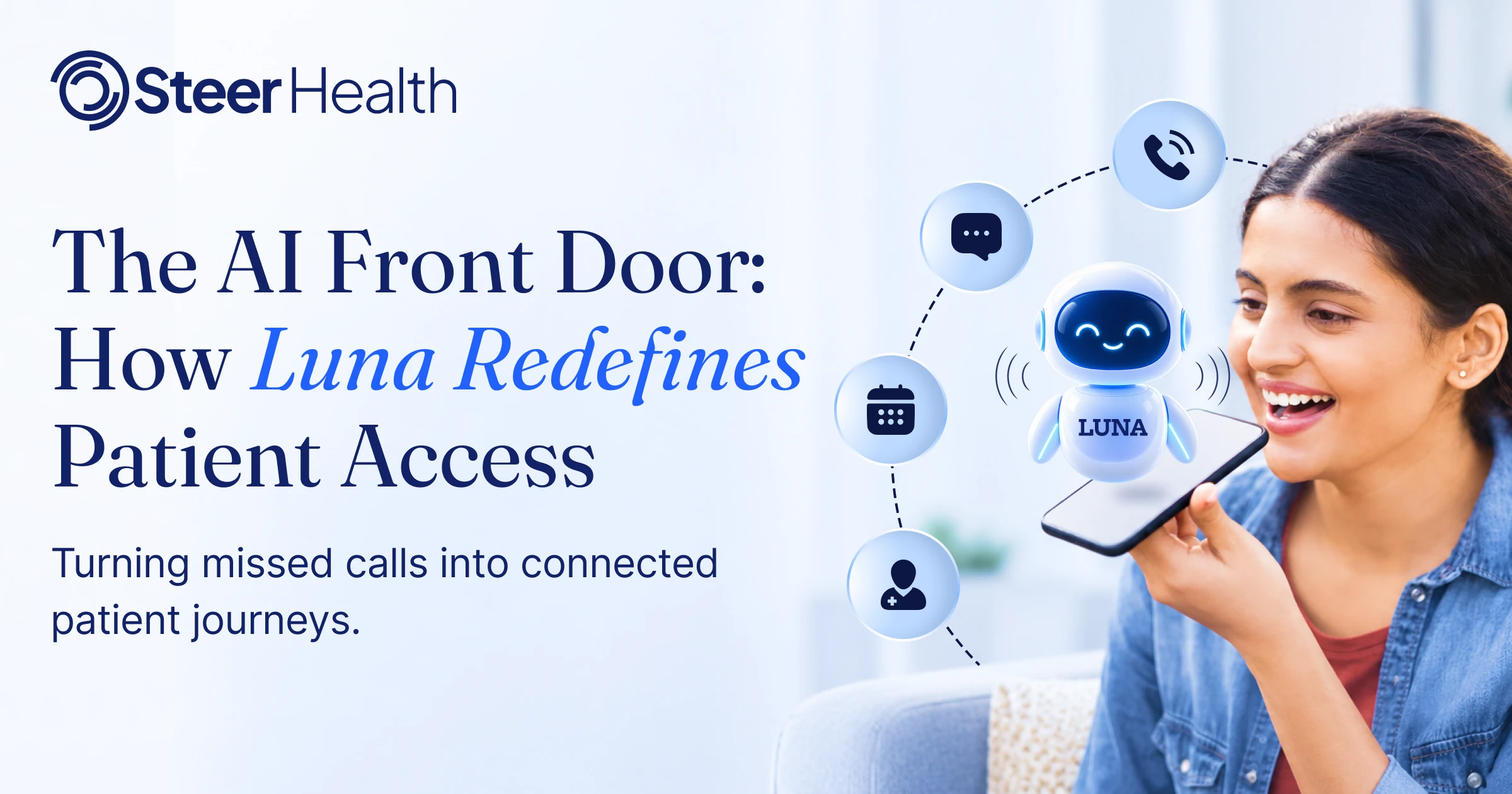
The AI Front Door: How Luna Redefines Patient Access
It's a Saturday afternoon. A patient with a torn rotator cuff calls the only orthopedic group her surgeon recommended. The line rings four times, drops to a voicemail box that's full, and she hangs up. She doesn't leave a message. She opens Google and books the next available slot at a competing practice instead. Nobody at her original practice will ever know she called. The call log won't show a lost patient. It will show nothing at all. That's the part of the front door problem that doesn't show up in a dashboard: the calls nobody sees.
Who Owns the Front Door in Healthcare?
Why first contact has become the most contested asset in medicine, and how health systems take it back.
10 AI Lessons from Serving 21 Million Patient Lives
A few weeks ago I listened to a recording of a call that came into one of our partner hospitals at 2:47 in the morning. A daughter, calling for the third time that week, trying to get her father a cardiology follow-up after an ER visit. The referral had gone out days earlier and landed nowhere. Our voice agent found the order, verified his insurance, and booked the appointment in under four minutes. What stayed with me wasn't the technology. It was the pause at the end of the call, and then: “Wait, that's it?” That pause is why we do this.
Clinical AI Notes: The Complete Guide for Doctors
Most doctors can describe the exhaustion of spending half their day charting in the EHR. Few realize that standard ambient scribes just trade manual typing for a new copy-and-paste bottleneck. Moving past simple transcription to a fully integrated, agentic workflow is what adopting true clinical AI notes is actually about.
Orthopedic Referral Management: How to Stop Leakage Before It Starts
Orthopedic referral leakage starts the moment a referral arrives and nobody acts, not at the no-show, and it shows up at five points across intake: arrival, verification, authorization, routing, and booking. Four of those five happen before scheduling, so preventing referral leakage means capturing, verifying, authorizing, and routing every referral on arrival rather than adding schedulers at the end.
A Referral Isn't a Phone Call or an Incoming Fax. It's a Workflow: Verified, Authorized, Booked
Most orthopedic MSOs can describe exactly how a referral arrives. Few can describe what happens to it next, and that gap is where growth quietly leaks out of the portfolio. Treating that gap as a discipline, not an afterthought, is what orthopedic referral management is actually about.
What This Award Means to Us
Receiving the 2026 Hearst Health Prize is an incredible honor for everyone at Steer Health. We see this recognition as an opportunity to talk about a problem that deserves far more attention: the hidden gap between when patients decide to seek care and when they actually receive it.
Healthcare Workflow Automation: The Operating Layer That Sits Above Your EHR
EHRs function as systems of record but don't manage the day-to-day workflows happening across multiple tools. Workflow automation bridges this gap by orchestrating processes like intake, referrals, and rebooking across systems. This unified layer reduces manual work, closes care loops, and improves overall operational efficiency.
The Real Cost of Automation in Healthcare: A 2026 Breakdown for Operations Leaders
Healthcare automation ROI hinges on integration, data readiness, and change management—not just time saved. Many pilots fail to scale, making workflow fit and real costs critical. Clear baselines and focused use cases drive the best returns.
Get the next one in your inbox.
We publish practical, no-hype writing on running healthcare operations in the AI era. Book a demo and we'll keep you on the list.
What This Blog Covers
This blog covers the operational realities of deploying AI in healthcare — not the theory. Practical breakdowns of what works in referral automation, prior authorization, AI triage, care gap closure, no-show reduction, and patient reactivation. We publish implementation guides, ROI frameworks, and case study analyses written by the Steer Health team.
Who This Is Written For
Healthcare operations leaders, patient access directors, revenue cycle managers, and practice administrators who have moved past whether AI can work in healthcare and are asking how to make it produce measurable results. Posts are practical, specific, and grounded in live deployment data.
Key Topics Covered
AI patient scheduling and no-show reduction, prior authorization automation, care gap closure and HEDIS outreach, physician burnout and AI medical scribes, digital front door and patient access strategy, and agentic AI versus traditional workflow automation. New posts publish weekly.
Benchmarks From Live Deployments
Posts regularly cite live deployment benchmarks: 38% reduction in unfilled appointment slots, 42% hospital readmission reduction, 89% prior authorization approval rate, 2+ hours per clinician saved daily, 99% patient satisfaction at OC Surgeons, no-show rate reduced from 22% to 5.2% at Coastline Ortho.