Summarize this blog post with:
 ChatGPT
 Perplexity
 Claude
 Grok
A cardiologist refers a patient to endocrinology. The referral lands in a shared inbox that three people check on different schedules. Endocrinology's scheduler is out that day. The patient calls two days later, gets a general line, gets transferred twice, and books three weeks out because nobody at the front desk knows endocrinology keeps two slots open every morning for exactly this kind of referral. The visit happens eventually. The conversion, the fast, frictionless handoff that keeps a referred patient inside the network, already didn't.
Nothing about that story is a technology failure. It's a structure failure. There was no single function accountable for what happens to a referral between the moment it arrives and the moment it's booked. That function has a name, and healthcare operators have known it for decades: central scheduling.
What Central Scheduling Actually Is
Central scheduling is a single department, line, and rule set that manages appointment scheduling across every location and specialty in an organization, instead of leaving each office to run its own version of the process. MGMA has described the model for years in almost identical terms: one team, standardized workflows, one point of accountability for wait times, phone answer speed, and no-show rates, replacing a patchwork of office-level scheduling desks that each do it differently. [Source: MGMA]
The logic is simple. A referral, a self-scheduled visit, and a recall reminder are all the same underlying event: demand that needs to land on the right provider's calendar, verified and authorized, before the patient loses interest or the referring physician loses confidence. Route all of that through one function with one set of rules, and you get consistency. Route it through a dozen office-level processes, and you get exactly the cardiologist-to-endocrinology story above, repeated hundreds of times a month, invisibly.
Why Most Organizations Never Actually Built One
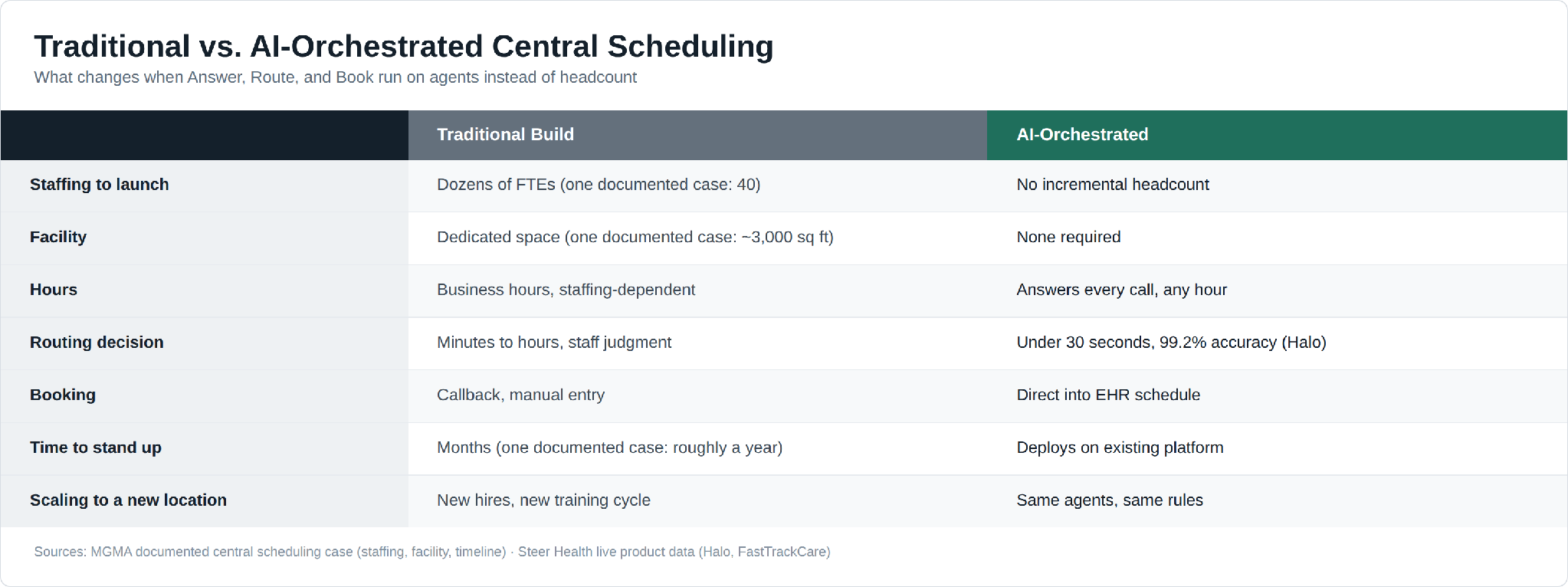
If the model is this well understood, why do so few health systems run it well? Cost and complexity. One MGMA-documented case from a mid-sized medical group makes the math plain: standing up a central scheduling department to serve roughly 128,000 patients and 1,080,000 annual appointments called for a projected 40 full-time staff and about 3,000 square feet of space, with a first-year payback only after full implementation. Even with a fully staffed team, meeting industry benchmarks remains challenging.
That's not a knock on the operators who built it. It's the honest ceiling of a model that depends on hiring, training, and scheduling dozens of humans to answer, verify, and route calls all day, every day, at a pace that keeps up with demand. Most specialty groups and mid-sized systems looked at that build and, reasonably, didn't.
The Access Problems Central Scheduling Was Built to Fix Are Still the Top Problems
They haven't gone anywhere. In MGMA's own December 2025 poll of 236 medical group leaders on their top 2026 patient access priority, no-shows led at 27%, followed by online scheduling at 24%, phone access at 22%, and wait times at 21%, essentially a four-way tie among the exact problems a central scheduling function exists to solve. [Source: MGMA, "Patient access priorities for 2026"]
Two figures inside that poll are worth sitting with. First, no-shows and last-minute cancellations are estimated to consume roughly 14% of a medical group's revenue on an average day, translating to losses of around $150,000 annually per physician in some models. Second, a July 2025 MGMA poll found that 71% of medical groups still have fewer than one in four patients using digital tools to schedule at all, meaning the phone remains the primary scheduling channel for most patients at most groups, three-plus years into the industry's digital scheduling push. [Source: MGMA, "Patient access priorities for 2026"]
Put those together and the picture is a scheduling function that is still, structurally, understaffed and still, structurally, phone-dependent, at the exact organizations that would benefit most from centralizing it and couldn't justify the build.
What Changes When the Function Is AI-Orchestrated Instead of Headcount-Built
The central scheduling model was never wrong. The delivery mechanism was the constraint. Running it through agentic AI instead of a headcount-heavy call center removes the part that made it unaffordable, without touching the part that made it work.
Strip a central scheduling department down to what it actually has to accomplish, and every version, staffed or AI-orchestrated, is doing the same three jobs in the same order: answer, route, book. Miss any one of them and the referral stalls somewhere between the fax machine and the calendar. Inside FastTrackCare, those three jobs run continuously instead of waiting on staffing levels.
1. Answer. Luna, the AI voice agent embedded in FastTrackCare, is the single line every call, text, and web inquiry reaches. She answers live, at any hour, and handles new patient booking, rescheduling, insurance questions, referral intake, and reminders in one continuous conversation instead of a transfer chain.
2. Route. Halo, the triage and scheduling agent, is the routing decision. She evaluates patient symptoms in under 30 seconds with 99.2% triage accuracy, sends each patient to the right care setting (ER, urgent care, telehealth, or a specific specialty slot), and hands straight into scheduling once that decision is made. In live deployments she diverts 35% of cases away from the ER to a more appropriate, lower-cost setting, the same acuity-based judgment a central scheduling department's most experienced staff are trying to make by ear on every call.
3. Book. FastTrackCare is what makes the booking capacity aware: demand gets pointed at open slots across the whole network, not stacked onto whichever provider's number the patient happened to call, and every booking lands directly in the EHR schedule instead of a callback queue someone has to work later.
Answer, route, book. A traditional central scheduling department needs 40 people to do those three jobs at volume. Here, three agents on one platform do them continuously.
Traditional vs. AI-Orchestrated Central Scheduling
This Isn't Theoretical: Days to Under an Hour
Neurology Associates of Texas ran into the same fragmentation most specialty practices do: referrals arriving by fax, phone, patient portal, and provider handoff, each one needing a staff member to key in demographics, verify insurance, and chase the patient down before the referral went cold. The process took days, and high-intent referrals lost momentum before anyone booked them.
After FastTrackCare's referral automation went live inside NATX's existing athenahealth workflow, capturing referrals across all four channels, verifying eligibility, matching patients to the right provider and location, and booking with write-back to athena, the timeline from referral to booked appointment dropped from days to under an hour. Eligibility verification is now 99% automated, and the practice is projecting 2,729 staff hours saved monthly. In the office manager's own words: "Now a referral comes in and it is checked, booked and sitting in athena before I have even opened it."
That's the Answer, Route, Book framework running end to end, on a real EHR, at a real practice, not a hypothetical.
Referral Conversion Is the Scoreboard, Not Calls Handled
We've written in depth about exactly where referrals leak inside a specialty organization, from the fax queue at arrival through prior authorization to the routing decision. Orthopedic Referral Management: How to Stop Leakage Before It Starts and A Referral Isn't a Phone Call or an Incoming Fax. It's a Workflow go deep on those mechanics for orthopedic MSOs specifically. Central scheduling is the operational layer that sits underneath all of it: the function that has to exist for any of those individual fixes to compound into a system, rather than staying a collection of point improvements in different departments.
The metric that actually proves it worked isn't calls answered or referrals logged. It's completed, attended, billed visits, the same distinction we've made before between activity metrics and outcomes that actually close the loop. The Outcome Gap Behind Your Patient Engagement Metrics. A central scheduling function, AI-orchestrated or not, is only doing its job if the referral that arrived on Monday is a kept appointment by the following week, not just a faster hold time. NATX's own number, days to under an hour, is what that looks like when it's actually working.
The Model Was Always Right
Central scheduling has been the documented answer to fragmented patient access for over a decade. What changed isn't the model. It's who can afford to run it. A function that used to require a facility, a 40-person roster, and a year of build-out now runs on the platform that also answers the phone, triages the symptom, and books the visit.
Book your Lost Demand Assessment to see what central scheduling, run by Luna, Halo, and FastTrackCare, would convert inside your own referral volume.