Summarize this blog post with:
 ChatGPT
 Perplexity
 Claude
 Grok
Most voice AI buying guides tell you to grade a vendor on containment: the share of calls the agent resolves without a human. Containment is a call center metric. Nobody in your boardroom is paid on it.
The asset your organization sells is provider time. Every unfilled slot at 5 p.m. is revenue that expires, like an empty airline seat at departure. A voice agent can answer 100% of your calls and still leave your schedule 81% full, your newest surgeon half booked, and your highest-value visit types stuck behind a three-week wait.
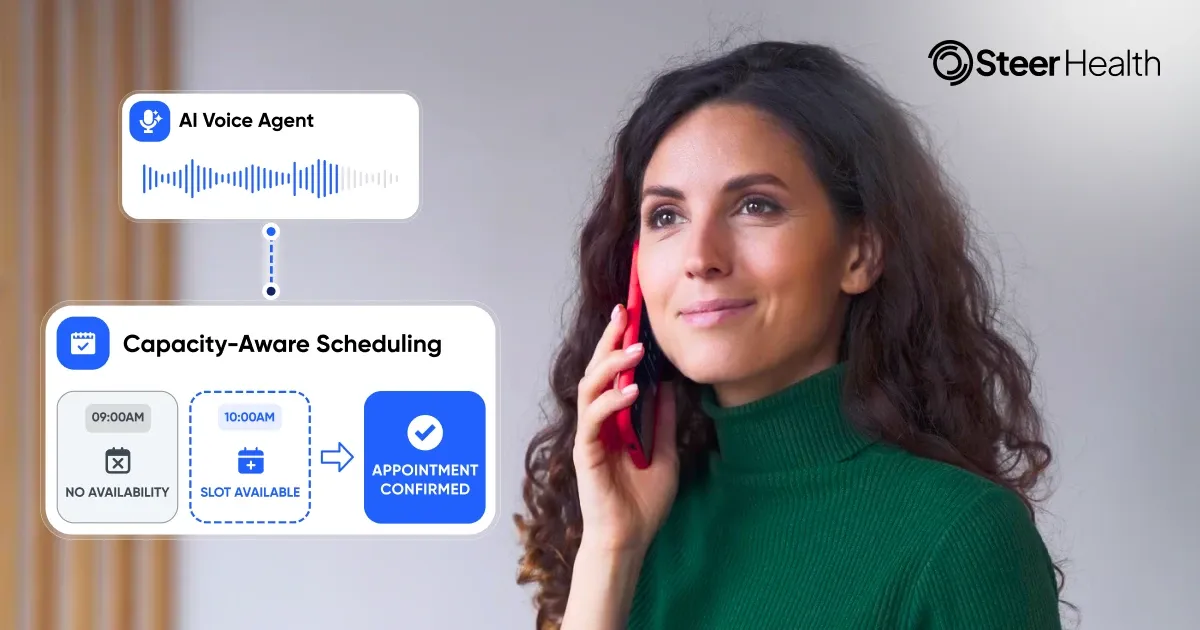
So the real test of healthcare voice AI is not "did the call get answered?" It is "did the right patient land in the right slot, with the right provider, and did the slot stay filled?" That is capacity optimization, and it is where a polished demo and a production deployment diverge the most.
The ten questions below are built around that test. Four address capacity directly. Six cover what has to be true around it: demand that never calls, clean bookings, control of the rules, EHR depth, PHI handling, and pricing. Ask them of every vendor on your shortlist, including us.
Capacity is the asset. The phone is one way in.
Run the math on a typical specialty group. Ten providers, 20 slots each per day, 240 clinic days a year: 48,000 slots to sell. At 81% utilization, 9,120 of them go unused. Moving to 98% recovers 8,160 visits. At an illustrative $200 of net revenue per visit, that is $1.63 million a year, before any downstream imaging, procedures, or surgery.
Those two utilization figures are real. Steer Health customers run 98% full schedules against an 81% average for specialty clinics, and a 2.2% no-show rate against a national average of 18 to 20%.
Three things make capacity hard, and none of them is solved by picking up the phone faster:
- Mismatch. Demand piles onto senior providers and popular locations while open slots sit a few miles away.
- Leakage. Cancellations, no-shows, and reschedules open slots too late for staff to refill them.
- Blind demand. Referrals, web visitors, and ad traffic arrive with no connection to where the schedule has room.
A vendor that only measures calls cannot see any of the three.
Four questions about capacity
1. What will you do to our schedule utilization, and will you put it in the contract?
Ask for before and after numbers on schedule fill rate, revenue per provider day, third next available appointment, and no-show rate, from a named customer in your specialty. Containment and hold time belong on the report too, as supporting metrics. A vendor who can only show call statistics is selling you a phone system.
2. Does the agent see capacity across every provider, location, and visit type?
Most agents offer the first open slot for the provider the patient asked for. A capacity-aware agent knows the new associate has openings this week, that the satellite clinic can see the patient tomorrow, and that a surgical consult slot should not be spent on a visit a PA can handle. Ask the vendor to show, live, how the agent chooses between three valid slots, and whose rules decide: provider preference, payer, visit type, sub-specialty, and urgency.
3. What happens in the first hour after a slot opens up?
Cancellations are the most perishable capacity you have. Ask whether the platform runs an automated waitlist, how it decides who is offered the slot, on which channels, and how fast. Then ask how it prevents the opening in the first place: confirmations, pre-visit prep, and payment before arrival all reduce no-shows. Request one number: of the slots opened by cancellation last month, what share were rebooked?
4. Can you create demand where we have room?
Inbound voice AI waits for the phone to ring. Capacity optimization also works in the other direction. Ask whether the platform can see open capacity by provider and service line, then point outbound work at it: unscheduled referrals, overdue follow-ups, dormant patients, and paid campaigns. Ask for attribution from ad click to booked visit to completed visit to revenue. If your marketing spend drives calls to a provider who is booked for six weeks, you paid to build a wait list.
Six questions about everything around the schedule
5. What happens to demand that never calls?
Patients arrive by web, chat, text, and fax as well as phone. Referrals are the clearest case: an estimated 40% are abandoned before a visit ever happens. Ask whether faxed and electronic referrals are worked automatically, first in, first out, and whether one set of scheduling rules governs every channel. A voice-only agent optimizes one door of a building with five.
6. Is every booking financially clean?
A filled slot that ends in a denied claim or an unpaid balance is not optimized capacity. Ask whether the agent verifies eligibility at booking, applies payer and visit-type rules, and collects copays and unmet deductibles before the visit.
7. Who owns the scheduling rules after go-live?
Templates change every week: a provider adds a clinic day, a payer rule shifts, a new location opens. Ask who can change the agent's rules and how long it takes. If every change is a vendor ticket, your capacity logic will always run weeks behind your schedule. Your operations team should be able to edit rules, guardrails, and escalation paths themselves, once, for every channel.
8. Does it read and write to our EHR in real time?
Ask whether availability is queried live or cached, whether confirmed appointments write back immediately, and what happens when the EHR is down. Cached availability produces double bookings, and your staff does the cleanup. Then ask for a reference customer on your exact EHR, not a logo on a slide.
9. Where does our PHI go, and what governs the model?
Require a signed BAA before any pilot, a full list of sub-processors with downstream BAAs, and contract language barring your PHI from model training. Then go one step further. Ask how the vendor tests for hallucination, what the agent is forbidden to do, when it escalates to a human, and which responsible AI standards it is held to.
10. What does it cost when it works?
Per-minute and overage pricing charges you more as volume grows, which is the outcome you bought the product to create. Ask for the total cost at twice your current volume. Ask for the exit clause if utilization targets are missed. Then call the reference customers yourself.
Change the scorecard
Bring this table to your next vendor call. The left column is what most vendors report. The right column is what your CFO will ask about a year from now.
| What most vendors report | What to require instead |
|---|---|
| Containment rate | Schedule fill rate by provider and location |
| Hold time and abandonment | Time from first contact to booked visit |
| Appointments booked | Completed visits and revenue per provider day |
| After-hours calls answered | Share of cancelled slots rebooked |
| Outbound calls placed | Referrals and dormant patients converted to visits |
| Minutes used | Fixed total cost, with no overage |
How Steer Health answers
Steer Health is the AI-Native Growth Platform for Healthcare Providers. FastTrackCare, our growth product, is built around capacity instead of calls. It combines omnichannel patient capture, referral automation, waitlists, patient reactivation, and eligibility and payments, with the Luna voice agent embedded as one channel among them.
| Question | What Steer Health delivers |
|---|---|
| 1 to 3: Capacity | 98% full schedules against an 81% specialty average, and a 2.2% no-show rate against 18 to 20% nationally |
| 4: Demand | Capacity-aware outreach and campaigns pointed at open slots, with attribution from click to completed visit |
| 5: Referrals | Referrals worked first in, first out, with the backlog eliminated |
| 6: Clean bookings | Over 92% of copays and unmet deductibles collected before the visit |
| 7: Control | Rules and guardrails live in Steer Studio, edited by your staff and IT, inherited by every channel |
| 8: Integration | 36 EHR integrations, including Epic, Oracle Health, MEDITECH, athenahealth, eClinicalWorks, NextGen, Greenway, and ModMed |
| 9: Trust | Member of the Coalition for Health AI (CHAI) |
| 10: Pricing | Fixed costs and no overage fees |
The result is an average of $3.5 million in incremental net revenue per customer and a 76% reduction in repetitive staff tasks, across 109 organizations, 472 locations, and more than 60 hospitals. Steer Health won the 2026 Hearst Health Prize and is a KLAS Emerging Solutions Top 20 company.