Summarize this blog post with:
 ChatGPT
 Perplexity
 Claude
 Grok
For decades, medical practice managers treated after-hours telephone coverage as an unavoidable administrative expense. When clinic doors closed for the evening, inbound calls transferred automatically to third-party call centers where operators logged basic contact details before paging on-call physicians. That legacy setup was designed in an era before digital health records, instant messaging, electronic prescribing, or real-time schedule synchronization. Today, relying on a traditional physician answering service creates operational friction, floods on-call providers with non-urgent distractions, inflates staff overtime, strains front-desk resources, and leaves valuable appointment capacity unbooked.
Forward-thinking medical groups are shifting away from passive call centers. Practice administrators and chief operating officers increasingly recognize that answering calls is only the first step in patient access. The true benchmark of operational success is filling provider schedules while capturing patient demand around the clock. Healthcare organizations are upgrading to AI-first architectures to capture every inquiry, automate routine administrative tasks, eliminate hold times, capture patient demand, and convert phone volume into measurable practice growth.
What a Doctors Answering Service Does in Modern Practice
To understand why healthcare delivery models are evolving, practice leaders must examine what a doctors answering service accomplishes within daily clinical workflows. Traditionally, a dr answering service served as a basic answering service for physicians, picking up line overflow during lunch hours or taking messages overnight. Operators logged caller names, captured contact details, recorded brief descriptions of clinical complaints, and forwarded physical notes to the office for morning processing.
When a physician call answering service relies on manual message relay, operational debt accumulates quickly. A doctor answering service operator lacks access to provider calendars or electronic medical records, meaning even simple appointment inquiries get converted into callback tasks for clinic receptionists. In a busy doctor’s office answering service environment, staff spend hours returning calls, chasing patients through phone tag, resolving portal backlogs, and manually re-entering intake details into chart records. Modern healthcare operations require an answering service for doctors that moves beyond message deferral to provide direct inquiry resolution.
Physician After Hours Answering Service and Patient Safety Evidence
The most critical operational risk in a legacy physician after hours answering service lies in how after-hours clinical calls get handled. In standard call center setups, operators rely on basic scripts or require callers to self-identify whether their medical concern constitutes a true emergency.
Peer-reviewed clinical research published in the Journal of the American Board of Family Medicine and the Journal of Family Practice highlights the severe safety risks of patient self-screening. When answering services require untrained callers to decide whether their concern warrants waking an on-call doctor, 93% of practices place the burden of triage on the caller. In physician audits of these held calls, doctors reported they would have wanted to speak to the patient that evening in 50% of cases, with follow-up audits showing 3% of patients suffered clinical harm and 26% experienced prolonged discomfort due to the delay. Documented cases held overnight included patients calling with "34-week obstetric, contractions,""pain in chest and going down left arm," and a "1 week old, vomiting, crying" whose calls were delayed because the caller demurred when asked if it was an emergency.
A physician after hours call center must never place the burden of clinical evaluation on an untrained caller or an unlicensed operator. Clinical triage requires licensed medical judgment or standardized protocols. An AI-first answering service for doctor's office environments removes caller self-screening entirely, automating administrative tasks while immediately forwarding every clinical symptom or urgent concern to covering providers based on pre-configured practice rules.
Answering Service for Doctors Office Overflow and Daytime Coverage
While after-hours coverage remains essential, daytime front-desk overflow represents a major source of lost revenue and staff burnout. Inbound calls to a physician office answering service frequently spike during morning check-in windows, causing long hold times and call abandonment rates as high as 40 percent. When patients encounter busy signals or extended wait times, many hang up and call competing clinics, creating immediate revenue leakage.
Deploying an answering service for doctors office daytime operations provides immediate capacity relief for clinic staff. An intelligent virtual receptionist picks up overflow calls on the first ring, handling routine patient requests without placing callers in queuing lines. Front-desk team members can dedicate their full attention to in-person patient check-ins and clinical support rather than constantly answering ringing phones.
Specialty medical groups with distinct scheduling rules benefit significantly from this rules-aware automation. Deploying AI patient access for specialty practices ensures custom booking guardrails, visit-type duration rules, provider slot allocations, and location preferences are enforced on every call. Surgical facilities and orthopedic groups can similarly utilize an answering service for orthopedist workflows or an answering service for ambulatory surgery center operations to streamline patient intake and protect high-value clinical schedules.
Answering Service for Doctors: Comparing Human Call Centers and AI
When evaluating an answering service for doctors, medical group executives often compare traditional human call centers against AI-first conversational platforms. Human answering services for doctors provide a familiar greeting, but they operate as cost centers that scale linearly with call volume. Human operators cannot access live electronic health records, check slot availability, book appointments directly, or verify insurance coverage in real time.
Conversely, modern AI conversational engines process multiple incoming calls simultaneously without queuing delays. By integrating directly with clinical software, AI agents identify existing patients through date of birth verification, check real-time schedule availability, verify active coverage, and complete routine administrative workflows autonomously. For practices comparing a human doctor answering service with software-driven automation, the primary advantage of AI lies in its ability to resolve inquiries instantly rather than creating callback backlogs.
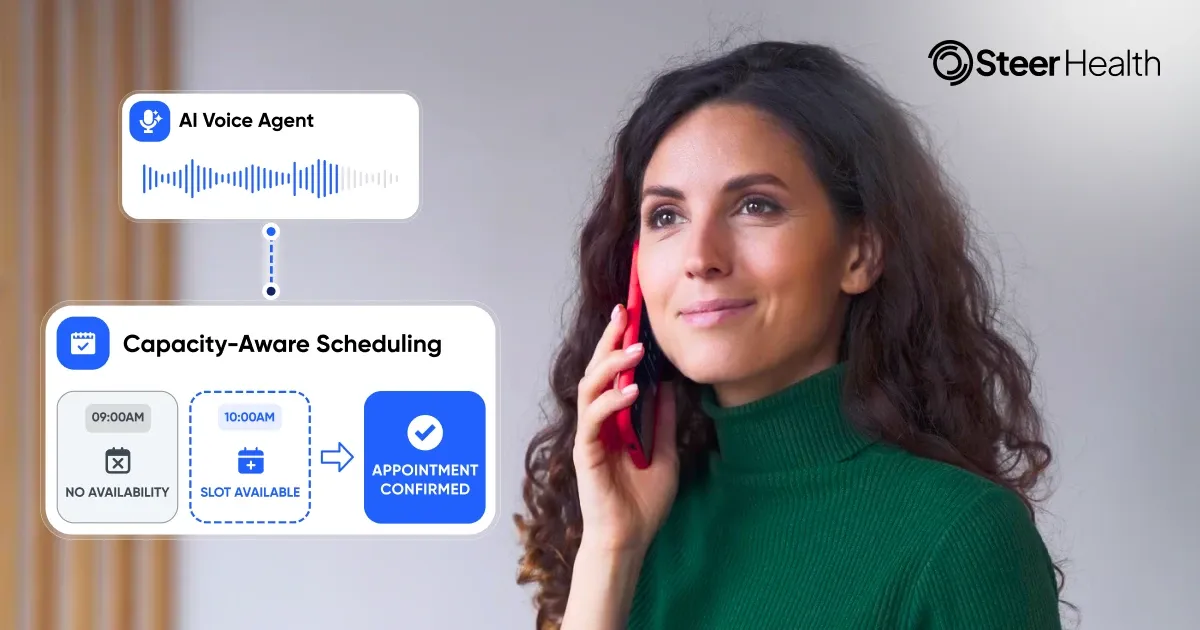
Steer Health addresses this challenge through an AI-native growth and access platform designed around capacity utilization. As the primary engine for patient acquisition, FastTrackCare, the omnichannel AI front door captures patient demand across voice, web, chat, text, web forms, patient portals, and referrals. Embedded within this platform is Luna, the AI voice agent embedded in FastTrackCare, who answers incoming calls instantly and executes complex scheduling workflows without staff intervention.
Physician Answering Service Software and EHR Integration
The technical foundation of modern physician answering service software is deep electronic health record integration. Legacy physician call center operations rely on isolated software that generates emailed summaries, faxes, portal messages, or physical printouts. Front-desk receptionists must manually transcribe these records into chart files every morning, introducing transcription errors, fragmented documentation, delayed callbacks, and administrative delay.
Advanced physician answering service software functions as a direct extension of the electronic health record. Utilizing FHIR R4 and HL7 interoperability standards, platforms like Steer Health maintain two-way integration with leading EHR systems including Epic, Oracle Health, MEDITECH, athenahealth, eClinicalWorks, NextGen, ModMed, Greenway, and AdvancedMD. The EHR serves as the system of record, while the AI platform acts as the system of action. Every completed booking, insurance verification, patient update, and after-hours encounter writes back directly to the chart with timestamped documentation.
Protocol-Driven Escalation in a Physician Nurse Answering Service
While administrative tasks can be automated end-to-end, clinical calls demand strict boundaries. An AI voice agent must never attempt clinical triage or offer medical advice. In a modern physician nurse answering service architecture, the platform uses natural language understanding to recognize clinical intent and execute deterministic escalation protocols established by practice leadership.
When a caller describes acute physical symptoms, the AI agent detects the clinical nature of the call instantly. Following pre-configured practice rules, the system initiates a priority transfer to an on-call physician, a nurse triage line, or a clinical triage team. Unlike traditional call centers that send vague handwritten notes, the platform delivers a structured digital payload containing verified patient identification, verbatim call audio, exact transcripts, active medication profiles, recent encounter notes, and historical chart records.
Delivering full chart context to on-call providers drastically reduces cognitive strain during off-hours coverage. Seeing exact caller statements alongside active prescription lists allows physicians to make informed clinical decisions rapidly without searching through chart records. Integrating structured handoffs to the on-call team closes critical communication gaps in patient care, ensuring clinical transfers remain seamless, accountable, traceable, and fully documented. Practice leaders evaluating these capabilities alongside broader AI call centers in healthcare can establish standardized routing across all patient touchpoints.
Physician Call Center Operations for Multi-Site Groups
As medical practices consolidate into multi-site medical groups, management services organizations, ambulatory networks, and private equity health systems, managing call operations becomes increasingly complex. A centralized physician call center handling phone traffic for dozens of clinic locations frequently struggles with varying provider schedules, localized routing rules, complex call trees, and high call volumes.
Deploying AI-first physician call center infrastructure enables health systems to centralize intake while maintaining localized scheduling rules. Intelligent software applies location-specific provider preferences, payer rules, clinic hour constraints, and appointment duration rules automatically. Centralized operations dashboards provide health system leaders with full visibility into call resolution rates, schedule utilization, patient abandonment rates, and patient acquisition metrics across every clinic location.
Physician Answering Service Cost and Pricing Models
Understanding physician answering service cost requires practice managers to analyze both direct invoice pricing and indirect operational expenses. Traditional live-operator services typically bill using per-minute or per-call pricing structures. While baseline monthly fees may appear low, costs escalate rapidly during high-volume periods. In addition, traditional per-call billing hides the substantial cost of downstream callback labor required when operators merely take messages rather than resolving calls.
Modern AI-first platforms operate on flat-rate per-provider pricing or fixed monthly software subscriptions. Fixed pricing eliminates unpredictable monthly invoice surges while delivering unlimited call handling capacity. Because AI systems resolve routine inquiries on first contact, medical practices eliminate secondary callback labor, reduce front-desk overtime, prevent patient leakage, and capture previously lost appointment revenue.
Best Physician Answering Service Evaluation Checklist
Selecting the best physician answering service requires a rigorous evaluation of vendor security, EHR interoperability, clinical governance, and escalation workflows. Practice administrators should use the following evaluation criteria when reviewing prospective vendors:
First, verify HIPAA compliance and security governance. Ensure the vendor signs a comprehensive Business Associate Agreement covering all data processing layers, enforces end-to-end encryption, maintains role-based access controls, and enforces multi-factor authentication. Before finalizing a contract, practice leaders should review essential questions to ask a voice AI vendor regarding data protection, cloud storage standards, audit logging depth, and vendor governance.
Second, confirm bidirectional EHR write-back depth. Test whether the platform writes completed appointments, demographic updates, insurance check details, and call documentation directly into your specific EHR version without manual re-entry.
Third, audit clinical escalation safeguards. Ensure the platform executes deterministic, protocol-driven transfers for urgent calls, delivering verbatim transcripts and active chart records directly to on-call providers. By selecting an AI-first platform built around these standards, healthcare organizations protect patient safety, eliminate front-desk burnout, maximize schedule utilization, improve patient access, and achieve sustainable practice growth.