Summarize this blog post with:
 ChatGPT
 Perplexity
 Claude
 Grok
The Unautomated Front Door of Healthcare
If you look closely at health system operations today, you will spot a glaring contradiction. Healthcare organizations spend millions of dollars building patient portals, launching digital marketing campaigns, and polishing their online presence. Yet when a patient actually needs to schedule an appointment, refill a prescription, or ask a question about a bill, they do not open an app.
They pick up the phone.
The telephone remains the most heavily used front door in healthcare. While almost every other industry has made instant service the standard, healthcare callers still routinely find themselves stuck in phone tree limbo. In a market where patients behave like modern consumers, long hold times no longer just cause frustration, but drive patients to hang up and call the clinic down the street.
When inbound calls go unanswered or end in lengthy hold queues, care access breaks down. In executive meetings, we call this patient drop-off. In reality, it is preventable revenue leakage.
To protect operating margins without overburdening exhausted care teams, health system leaders are changing their approach. Instead of viewing the contact center as an unavoidable operating expense, forward-thinking teams are deploying AI call centers in healthcare for their physician answering service. By placing voice AI alongside existing Electronic Health Records (EHRs), health systems are turning reactive phone lines into proactive, revenue-capturing access hubs.
Here is how modern voice AI works, why legacy tools fail, and how you can leverage voice AI to protect patient access while expanding EBITDA.
The High Cost of Silence: Where Patient Revenue Leaks
Let’s breakdown what actually happens when a patient dials your main line, with industry benchmarks across U.S. health systems:
- Long Hold Times: Average healthcare call center hold times range between 4.4 and 11 minutes, far exceeding standard service benchmarks.
- High Call Abandonment: Between 7% and 16% of callers hang up before reaching an agent.
- Unanswered Call Volume: On average, health systems fail to answer roughly 24% of all incoming calls.
- Daily Financial Loss: For a health system receiving 2,000 calls a day, a typical 7% abandonment rate equates to up to $45,000 in lost daily revenue.
- Unfilled Schedule Costs: Missed appointments and unmanaged schedules cost the broader U.S. healthcare system over $150 billion every year.
| Funnel Step | Metric / Operational Impact |
|---|---|
| 1. Initial Contact | Inbound Patient Calls |
| 2. Wait Friction | 4.4 to 11 Min Hold Time |
| 3. Call Deflection | 24% Unanswered / 7–16% Abandonment |
| 4. Financial Impact | Patient Drop-Off ➔ $45,000/Day Leaked Revenue |
At the same time, front office teams face immense strain. Contact center turnover in healthcare sits between 30% and 56% annually, driven by repetitive call volumes and administrative fatigue. Recruiting and training a single replacement agent costs $10,000 to $20,000, so trying to solve call surges by hiring more staff becomes financially unsustainable.
Why Rigid Phone Trees and Patchwork Tools Fail
For years, the standard response to high call volume was installing Interactive Voice Response (IVR) phone trees: "Press 1 for scheduling, press 2 for billing, press 3 to repeat this menu."
Touch-tone menus frustrate over 70% of callers, creating dead ends that lead to abandoned calls or forced voicemails that take days to return. Traditional IVRs do not resolve problems. They delay them.
| Traditional IVR (Interactive Voice Response) | Autonomous AI Voice Agent |
|---|---|
| Rigid touch-tone menus | Natural conversational speech |
| High deflection / forced VM | 60% to 80% autonomous resolution |
| Friction & patient drop-off | Sub-500ms real-time response |
| Disconnected from EHR write | Bidirectional EHR calendar booking |
Many organizations also fell into the point tool trap. Buying one software tool for online scheduling, another for automated SMS reminders, a third for intake forms, and a fourth for call answering creates software fragmentation. Front desk staff end up toggling between 7 to 13 separate portals while callers wait on hold.
To fix this, health systems are replacing single-purpose widgets with unified platforms that handle patient requests end to end.
How AI Call Centers Work
Modern AI call centers do not rely on rigid decision trees. They use natural language processing to hold fluid, humanlike conversations.
1. Sub-500ms Conversational Latency
Human conversation relies on immediate turn-taking. If an AI system takes two or three seconds to process a sentence, callers assume the line disconnected. Purpose-built voice engines operate with sub-500 millisecond response times. This allows callers to speak naturally, ask complex questions, or interrupt mid-sentence without breaking the interaction flow.
2. Running Adjacent to the EHR
Health systems have invested heavily in Electronic Health Records like Epic and athenahealth. An AI call center should never seek to replace the EHR. Instead, it respects clear architectural roles:
- The EHR is the System of Record: Holding patient charts, provider availability, and clinical histories.
- The AI Call Center is the System of Action: Operatingadjacent to the EHR via standardized HL7 FHIR R4 APIs to check live calendars, verify insurance eligibility, and book appointments directly into provider schedules in real time.
| Architecture Layer | Component & Details |
|---|---|
| Inbound Channel | [Inbound Patient Call / Web / Chat] |
| System of Action | [Steer Health: FastTrackCare + Luna AI Agent] |
| Integration Protocol | (FHIR R4 / HL7 Bidirectional Sync) |
| System of Record | [EHR: Epic / athenahealth / eClinicalWorks] |
3. Omnichannel Patient Capture with Steer Health
This is where Steer Health, the AI-Native Growth Platform for Health Systems, delivers immediate value. Steer’s lead product, FastTrackCare, acts as an omnichannel front door that captures patient demand across voice, web chat, text, and incoming referrals.
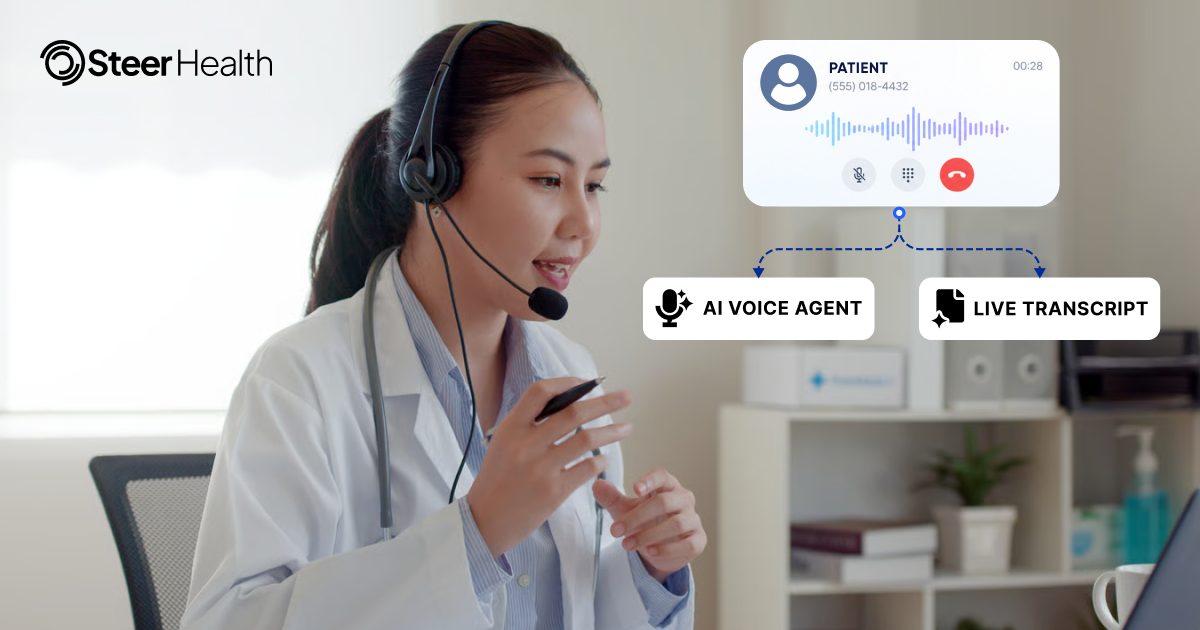
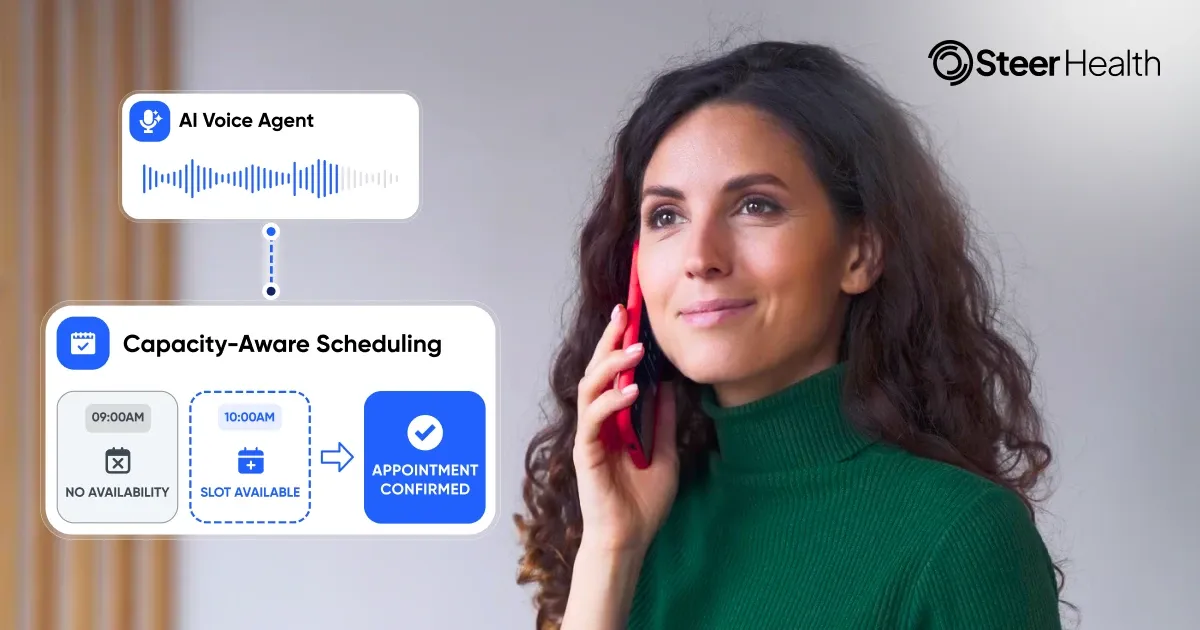
Embedded directly within FastTrackCare is Luna, an AI voice agent built specifically for healthcare phone calls. When a patient dials your main line, Luna answers on the first ring 24/7. She verifies caller identity, runs clinical triage protocols, and books appointments straight into your EHR schedule, escalating to live staff only when human clinical judgment is required.
The EBITDA Equation: Revenue Capture + Cost Removal
When presenting a voice AI initiative to your CFO or board, the business case rests on two direct levers that compound onto EBITDA
EBITDA EXPANSION FORMULA
High-Margin Captured Leaked Revenue+ Vendor & Staff Labor Cost Removal = Accelerated Bottom-Line Growth
Lever 1: Capturing High-Margin Revenue
Health systems rarely have a demand problem. They have a leakage problem. Unanswered calls, abandoned queues, and unfilled appointment slots represent earned demand that slips away.
Because clinical facilities, equipment, and provider salaries are fixed costs that are already paid for, capturing an incremental appointment or filling a last-minute cancellation delivers high-margin revenue. Nearly every dollar captured flows directly to the bottom line.
- No-Show Reduction: Automated conversational reminders and interactive rescheduling reduce no-shows by 39% to 45%, recovering over $100,000 in lost clinical margin per practice group.
- 24/7 After-Hours Booking: An estimated 11% to 24% of patient calls occur outside standard clinic hours. Autonomous AI agents answer evening and weekend calls, turning missed calls into confirmed bookings.
Lever 2: Consolidating Point Vendors and Lowering Operating Costs
By consolidating 7 to 13 single-purpose software tools onto one unified platform, health systems eliminate $770,000 to $1.9 million in annual software licensing and maintenance fees.
Simultaneously, shifting 60% to 80% of routine inquiries (scheduling, location details, prescription refills) to voice AI slashes handling costs from $6.00–$12.00 per live agent call down to $0.50–$2.00 per AI resolution. Production deployments achieve a 20% to 35% net reduction in total operating costs within 6 to 12 months, allowing your health system to scale access without ballooning headcount.
Governance, Security, and Compliance Safeguards
Deploying voice AI in healthcare requires strict security guardrails. Audio streams contain voice biometrics, and call transcripts contain Protected Health Information (PHI). An enterprise AI call center must adhere to established compliance standards:
- HIPAA Compliance & BAAs: Full alignment with HHS HIPAA Privacy and Security Rules, backed by signed Business Associate Agreements (BAAs) across every vendor in the pipeline.
- Zero Data Retention (ZDR): Ensuring patient data is processed in transit without being stored or used to train underlying third-party large language models.
- TCPA & FCC Compliance: Strictly adhering to FCC TCPA regulations for outbound communications by requiring explicit consent logs, upfront AI identification, and automated 2-second opt-out mechanisms.
- Deterministic Escalation: If an AI agent detects distress language, urgent symptoms, or low confidence, it executes an immediate warm transfer to live clinical staff, passing along the call transcript so the patient never repeats themselves.
Transforming Patient Access into an EBITDA Growth Engine
Healthcare call centers are undergoing a structural shift. They are evolving from stressful cost centers into smart access hubs that drive health system growth.
By replacing hold music and rigid touch-tone trees with sub-500ms conversational AI, health systems stop patient drop-off, support their care teams, and capture high-margin revenue that would otherwise walk out the door.
When every inbound call is answered on the first ring, no clinical slot stays empty, and every earned dollar reaches your bottom line.
Transform Your Patient Access Operations Today
Ready to eliminate hold times, stop revenue leakage, and unify your patient acquisition funnel? Discover how Steer Health's FastTrackCare Platform delivers an omnichannel AI front door that answers every call 24/7, integrates seamlessly with your EHR, and drives measurable EBITDA expansion.